Estate Planning Isn’t Just for the Wealthy—It’s for Anyone Building Something
- Travis Gasper
- 3 days ago
- 5 min read

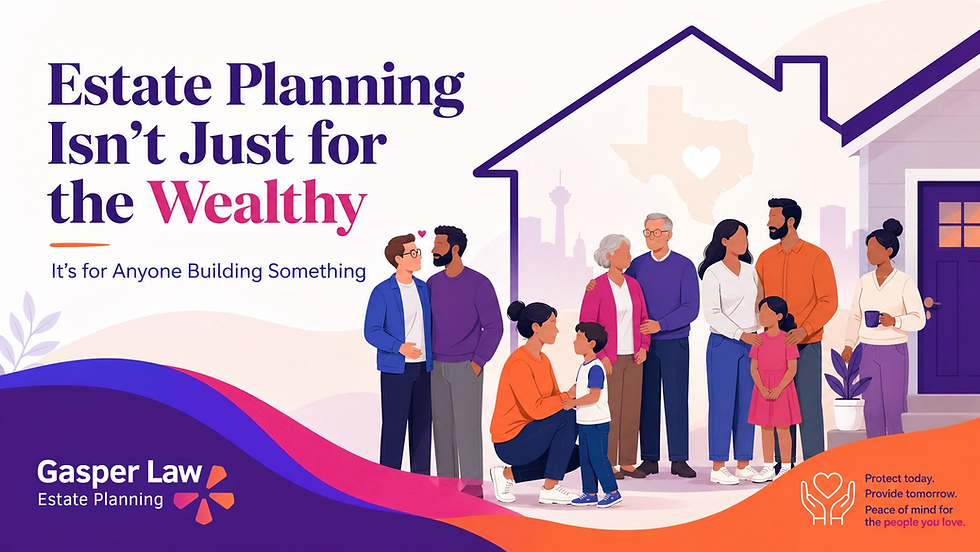
Estate planning has a reputation problem.
For too long, people have been told—directly or indirectly—that estate planning is only for wealthy families, complicated estates, or people with large investment accounts and multiple properties.
That myth leaves too many families without the clarity and protection they deserve.
Because estate planning is not just about wealth.
It is about protecting what you are building.
Your family. Your home. Your relationship. Your children. Your partner. Your chosen family. Your stability. Your peace of mind.
Recently, I led an estate planning session for the team at Habitat for Humanity Dallas. I went in ready to teach about wills, trusts, powers of attorney, beneficiary designations, and the planning tools families can use to protect themselves.
But during that session, something clicked.
The work Habitat Dallas does every day and the work estate planning does are deeply connected.
Both are about stability.
Both are about dignity.
Both are about protecting what people are working so hard to build.
And that is the heart of estate planning.
Estate planning is not just “who gets the stuff”
When people hear “estate planning,” they often think it means deciding who gets your property when you die.
That is part of it—but it is not the whole story.
A good estate plan can answer questions like:
Who can make medical decisions for me if I cannot speak for myself?
Who can handle financial matters if I am alive but incapacitated?
Who would raise my children if something happened to me?
Who should have legal authority to help?
Who should receive what I leave behind?
Who do I trust to carry out my wishes?
Those questions matter whether you have millions of dollars or are still building your foundation.
They matter if you own a home.
They matter if you rent.
They matter if you have children.
They matter if you are caring for a parent.
They matter if you are unmarried but in a committed relationship.
They matter if your closest people are chosen family.
They matter if your family is blended, multigenerational, LGBTQ+, Spanish-speaking, or simply does not fit neatly into the legal default.
Because the legal default does not always reflect real life.
Your life is not default
The law has default rules for what happens if you die without a plan or become incapacitated without the right documents in place.
But your life is not generic.
Your family is not generic.
Your relationships, responsibilities, values, and wishes may not match the legal default.
For some families, that matters a lot.
An unmarried partner may not have the authority you assume they would have.
Chosen family may be treated like strangers unless you give them legal authority.
A blended family may face confusion or conflict if the plan is not clear.
A parent may leave loved ones guessing about guardianship, finances, or medical choices.
A Spanish-speaking family may need a planning process that feels clear, respectful, and accessible—not confusing or dismissive.
Estate planning gives you a way to put your real life into a legal structure.
Not because you are expecting something bad to happen.
Not because you need to be afraid.
But because the people you love deserve clarity.
Estate planning protects stability
One of the reasons the Habitat Dallas conversation stayed with me is that Habitat’s work is centered on housing stability.
And housing stability is about much more than a roof.
A home can represent years of sacrifice.
It can represent safety after instability.
It can represent a new beginning.
It can represent the place where children grow up, families gather, and people imagine a different future.
Estate planning is one way to protect that stability.
It asks: What happens to what you are building if something happens to you?
Who can step in?
Who knows what you wanted?
Who has authority to help?
Who gets protected?
Who gets left vulnerable?
Those questions are not only for wealthy families.
They are for anyone who loves people and wants to make things easier for them.
You do not need everything figured out before you start
A lot of people delay estate planning because they think they need to get ready first.
They think they need a perfect asset list.
They think they need to know whether they want a will or a trust.
They think they need to organize every account, find every password, make every decision,
and have every family conversation before they can even begin.
You do not have to do that.
That is what the planning process is for.
The first step is a conversation.
A real conversation about who you love, what you are building, what you are worried about, who you trust, and what peace of mind would look like for you.
You are allowed to start before everything is organized.
You are allowed to start while life is still unfolding.
You are allowed to start even if you do not feel like you have “enough.”
Estate planning is not a reward you earn once everything is settled.
It is a tool that helps you create stability while life is still being built.
The people you love deserve more than a default
Estate planning does not remove grief.
It does not make hard things easy.
But it can make the path clearer.
It can give your people instructions.
It can reduce the number of decisions they have to make from scratch during a crisis.
It can help prevent the default legal system from making decisions that do not reflect your real life.
And sometimes, the greatest gift is not money.
Sometimes the greatest gift is clarity.
The people you love should not have to become legal detectives in the middle of a crisis.
They should not have to piece together your wishes from old conversations, assumptions, and group texts.
They should not have to wonder whether they are honoring you correctly.
A plan gives them something to hold onto.
That is not about wealth.
That is about care.
Ready to begin?
You do not need everything figured out before you start.
You do not need to know whether you need a will or a trust.
You do not need a perfect asset list.
You just need a place to begin.
When you are ready, you can book a Peace of Mind Planning Session with Gasper Law at gasperplan.com.
We serve families across Texas in English and Spanish, including LGBTQ+ Texans, chosen family, blended families, unmarried partners, multigenerational households, and people who simply want to protect the life they are building.
Your people deserve more than a default.
And you deserve the peace of knowing there is a plan.


Comments